
By Alok Mukherjee
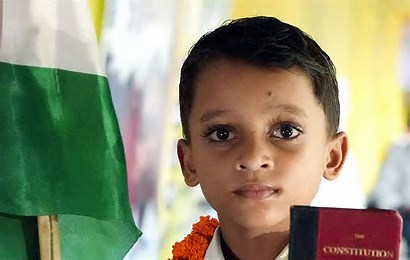
On August 25, 2026, police in Patna, the capital of the Indian state of Bihar, used batons and water cannons to break up a demonstration over alleged exam irregularities in the 70th Bihar Public Service Commission (BPSC) examination. Defying the helmeted riot police and its violent tactics, an extraordinary sight emerged: a six-year-old boy carrying the Indian Tricolour, surrounded by baton-wielding officers and a forest of television microphones.

Six-year-old Aditya Kumar with the Indian Tricolour and India’s Constitution during the student protest in Patna, Bihar. (Photo: ANI / Social Media)
When asked by eager reporters whether he was being arrested, the child turned the interrogation directly onto the police:
“Aap SP ho toh kya… police ka yahi kaam hai? Aapko patrolling karne ka kahin jagah nahi mil raha tha toh aap logon ne matha phudwa diya. Half murder hai ye… aapke upar toh 307 IPC ki dhara lagna chahiye.”
(So what if you are the SP [Superintendent of Police]? Is this what the police are supposed to do? You had nowhere to patrol, so you made people’s heads bleed? This is attempted murder… Section 307 of the IPC should be applied against you.)
At six years old, raised by a daily-wage father and a domestic-worker mother, this child grasped constitutional accountability far faster than the seasoned reporters holding the microphones—or the state officials ordering the police actions.
What we witnessed in Patna was a discombobulated political state, run by aging autocrats and octogenarians, entirely at a loss for how to respond. For over a decade, India’s ruling class has managed opposition through scripted narratives, controlled media, and partisan polarization. But they have no script for a six-year-old from the urban poor who speaks from raw, personal experience with no political ambition, no party handler, and no fear.
From Gen Z’s “Cockroach Janta Party” to Gen Alpha on the Streets
This incident is not an isolated flashpoint. It represents a broader, unprecedented shift in Indian youth activism.
What began as a satirical movement led by Gen Z under the banner of the Cockroach Janta Party (CJP)—formed in response to official slurs comparing unemployed youth to “cockroaches”—has metastasized into a grass-roots phenomenon. Now, Generation Alpha (children born between 2010 and 2024) is adopting the CJP framework to organize on the streets over immediate civic rights.
Building on this momentum, CJP organizers Abhijeet Dipke, Saurav Das, and Ashutosh Ranka endorsed the nationwide “School Theek Karo” (Fix Our Schools) campaign. Across states like Uttar Pradesh, Rajasthan, Bihar, and Madhya Pradesh, elementary and middle-school children are mobilizing:
- In Hamirpur (UP): Schoolchildren marched five kilometers to the district collectorate to demand a paved road to their school.
- In Fatehpur (UP): Students protested the lack of functional fans, clean drinking water, and basic sanitation.
- Hyper-Local Media Advocacy: Using short-form video and viral photos, children are converting local grievances—missing science teachers, collapsed roof tiles, unsafe transport—into national political issues.
The Decimation of the Public Classroom
The demands of these children point to a profound crisis in India’s public education. Over the past decade, under the guise of “school rationalization” and consolidation, central and state governments across the country have closed or “merged” more than 93,000 government primary and middle schools.
Uttar Pradesh alone has shuttered over 24,000 schools, followed by Madhya Pradesh with more than 22,000. These are two of India’s poorest states with very large populations, but their policies are by no means isolated. Their school-closure policy has forced working-class and rural children to trek several kilometers to reach the nearest state facility, drastically driving up dropout rates, particularly among young girls. Over the same period, government school enrolment dropped by over two crore (20 million) students, pushing poor families toward unregulated, for-profit private institutions.
Where public schools remain open, their physical condition is an insult to human dignity. Learning requires a welcoming, safe, and inspiring environment. Yet millions of working-class children enter classrooms with peeling plaster, leaking roofs, no electricity, and filthy, overflowing toilets that have been turned into storage sheds or left entirely unserviced. To subject children to such degradation is to tell them daily that their education—and their lives—do not matter to the state. It is very likely a violation of international obligations under children’s right to education.
Worse still is the systematic dismantling of the teaching profession itself. In state after state, full-time, permanent teachers have been replaced by temporary, contractual ad hoc staff hired on seasonal contracts. These “guest teachers” are paid minimal wages only when school is in session, stripped of job security, and forced to re-apply annually.
Education relies on relational continuity. A permanent teacher knows a child’s family, notices when a student is hungry, and serves as an anchor in marginalized communities. Reducing teaching to seasonal gig-work destroys pedagogical quality and severs the vital bond between state schools and poor neighborhoods.
The Fiscal Violence of Neoliberal Governance
When challenged on the state of public schools, governments plead “fiscal constraints.” Yet this claim collapses when examined alongside state priorities.
The state claims it cannot afford ₹15,000 a month for a permanent primary teacher or a few thousand rupees to repair a collapsed school roof in a village. Yet it easily absorbs trillions of rupees in corporate debt write-offs, grants tax concessions to private entities, and steadily expands its expenditure on security forces and riot-control hardware.
This is the core logic of the neoliberal state: it has rebranded public services like education and healthcare as personal choices. They are intentionally starved until they fail, at which point a service like education is reframed as a private commodity to be purchased by those who can afford it and not a fundamental public good.
A Pattern That Echoes Across the World
This is not a uniquely Indian story; it is part of a global assault on the democratic social contract.
In the wealthier West, the playbook is identical:
- In Canada (such as Ontario and Alberta): Decades of real-dollar funding cuts have created billions in school repair backlogs, while policy shifts push public resources toward private charter and voucher models.
- In the UK and USA: The aggressive conversion of local state schools into private academies or corporate charter networks funnels taxpayer money into private hands while draining neighborhood comprehensive schools.
Across both the Global South and Global North, the underlying ideology is the same: public education is no longer treated as a collective investment in societal well-being and democratic equality, but as an individual financial transaction. If you can afford private tuition, your child thrives; if you are poor, you are left with the scraps of an abandoned public system.
Two Personal Reflections: What Public Education Can Be
This battle is deeply personal to me.
1. The State That Made My Education Possible
I grew up in a poor family. My education was made possible only because the state at that time treated public education—from Grade 1 through university—as a vital national priority. Schools and universities were fully funded. Students who performed well were awarded automatic scholarships as long as they maintained their academic standing, and tuition fees were kept minimal.
Our primary schools were staffed with full-time, permanent teachers who knew our families. They provided well-stocked libraries, sports facilities, and nutritious daily lunches. Without those public provisions, I could not have received an education or built a career to pull my family out of poverty. My cousin, Bloomberg columnist Andy Mukherjee, has written eloquently about this shared family history.
This truth hit home vividly during an official visit to India in 2010, when I accompanied Toronto’s Chief of Police, Bill Blair. In Delhi and Mumbai, Chief Blair met members of the Mukherjee family, including Andy. Having heard how our family had once been reduced to abject poverty and had subsequently risen, Chief Blair remarked on what our journey demonstrated: the indispensable power of accessible, high-quality public education. It was only through state-funded education that we were able to succeed, lift ourselves up, and support one another to do the same.
The Indian state today has reneged on that foundational promise, abandoning its children and, with them, the nation’s future.
2. The Power of Community-Backed Public Schools
Over a decade ago, I visited a small elementary school in a village in Madhya Pradesh. When the new headmaster—a dedicated educationist and a good friend—was appointed, he arrived to find a dilapidated building, overgrown grounds, broken toilets used as storerooms, and chronic absenteeism among both teachers and students.
Rather than giving up, he convened a meeting of the villagers. He persuaded the local village council (gram panchayat) to allocate funds for physical repairs, engaged parents to prepare fresh daily meals, and worked alongside teachers to restore pride in the classroom. When the community and the state joined hands to create a clean, welcoming environment, the children eagerly showed up to learn. This is precisely what the “School Theek Karo” movement is demanding today.
The Message to the World
The six-year-old at the Patna barricades and the thousands of children organizing under the “School Theek Karo” banner are delivering a clear message to the world.
They are challenging an illiberal, market-driven political order that has abandoned its youngest citizens in pursuit of policies that serve the wealthy and privileged. They are re-asserting a simple, radical truth: a public school is not a commercial service or an act of charity. It is a fundamental right.
When six-year-olds must step up to press microphones to ask where the teachers, the books, and the clean toilets went, it signals that the governing class has failed. But it also signals that a new generation—Generation Alpha—refuses to let its future be erased without a fight.
This six-year-old from Patna, India, is sending out a message that should echo across our democratic world.


Leave a Reply